What ultra-high vacuum demands of surface, cleaning and packaging. With the cleaning process in five steps, where outgassing comes from, and answers to frequently asked questions.

UHV cleaning is about what remains on the surface: in ultra-high vacuum, those residues are released and contaminate the chamber. A component therefore needs a smooth, clean surface and cleaning that leaves no residues behind. After that, packaging and handling must not add any new contamination. Van Geenen cleans and packages components for UHV in its own cleanroom.
This applies to components that you have cleaned and packaged externally before they are used in vacuum. A laboratory's own procedure follows the guidelines of its institute or of the supplier of the vacuum system. The requirements start at the surface and carry on through to delivery to you as the customer.
Ultra-high vacuum (UHV) is a sealed environment from which almost all the gas has been pumped out. The gas that remains comes mainly from the chamber walls and from the components inside it.
Technical literature defines UHV in terms of pressure. The level your system has to reach is set out in your specification, and we match the cleaning to it. The difference from an ordinary cleanroom is one of scale: there it is about particles, while in ultra-high vacuum individual molecules count as well (molecular contamination).
Oil, grease, fingerprints, detergent residues and moisture sit on the metal as a thin film. As soon as the pressure drops, they slowly leave the surface as gas. This is called outgassing, and it slows down or prevents the system from reaching the required condition.
Each source of outgassing calls for its own measure.
Source of outgassing | What helps |
|---|---|
Fingerprints and grease | Thorough degreasing, then handling the component only with clean gloves |
Detergent residues or moisture | Thorough rinsing and complete drying, so that no agent or water stays behind in crevices |
Rough or porous surface | A smooth, closed surface that gives residues less to hold on to |
Packaging material that gives off gas itself | Packaging in material that does not outgas |
Dust and contact during handling | Working in a clean environment and leaving the component unpacked for as short a time as possible |
Ultra-high vacuum calls for a smooth, closed surface: it is easier to clean, because residues have less to cling to. Porous and rough material, crevices and an oxide layer act as hiding places, and whatever sits in them is released only later in vacuum. How smoothness and cleanability are linked is explained on our page about surface roughness. That is why surface preparation comes before cleaning, and cleaning before packaging.
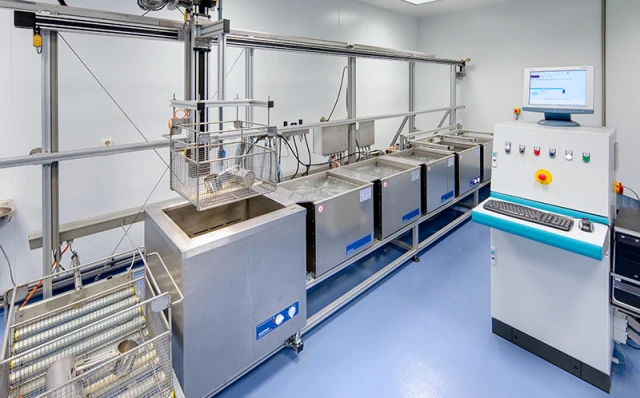
Van Geenen cleans in its own 300 m² ISO 7 cleanroom (Class 10,000). Cleaning is carried out at Grade 2 or Grade 4 level, two standards from the high-tech and semiconductor industry, with Grade 2 being stricter than Grade 4. There, vacuum-compatible cleaning takes place in five steps:
Mechanical surface preparation, where needed. A smoother surface holds less contamination and is easier to clean afterwards.
Pre-cleaning. Coarse contamination from production comes off first, because the oil and grease in it are a direct source of outgassing in vacuum.
Ultrasonic cleaning and the 4-phase wash line. Vibrations also loosen dirt from corners, holes and internal channels, where it would otherwise keep outgassing in vacuum.
UV inspection for micro-contamination. Under UV light, fluorescent residues that the naked eye misses, such as a thin oil film, become visible.
Dust-free packaging with non-outgassing materials and cleanroom-grade labels.
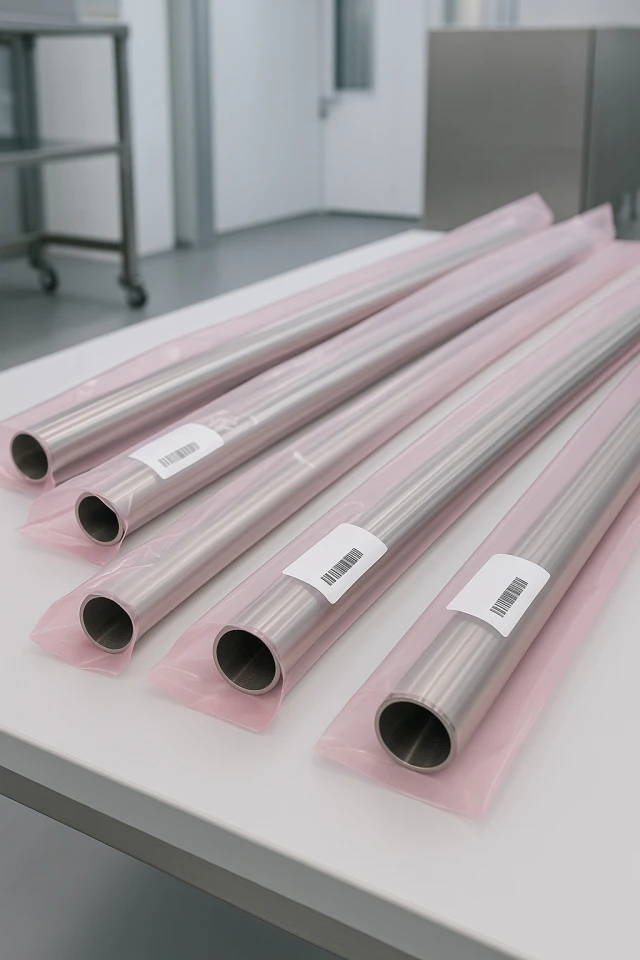
A cleaned component starts picking up whatever is in its surroundings from the very first moment: dust, moisture and the grease from a hand. Whether it stays clean enough for ultra-high vacuum therefore depends on what happens between cleaning and installation. Contact, dust and packaging material that gives off gas itself are the weak link at that stage.
Van Geenen packages cleaned components dust-free, in non-outgassing materials and with cleanroom-grade labels. Traceability stickers are available on request, so you can follow each component back through the process. There is no extra handover between cleaning and packaging, because both steps are part of the same process.
Whether a component is clean enough for ultra-high vacuum depends on the cleanliness requirement in your specification. At Van Geenen, every component goes through UV inspection for micro-contamination after cleaning. If you want it demonstrated that a component meets the outgassing requirements in your specification, residual gas analysis (RGA) can do that. An RGA measures which gases remain in a vacuum chamber, such as water or hydrocarbons from oil and grease.
In a UHV project, cleaning and packaging are followed by steps at system level, such as installation, bake-out and leak testing. Each of those steps places its own demands on the condition in which the component arrives. We agree with you in advance what those steps require of the cleaning and the handover.
At Van Geenen, mechanical surface preparation, cleaning, packaging and, if required, cleanroom assembly are part of one process. The component does not change supplier between those steps. This is also how we work for companies in the high-tech sector. Van Geenen B.V. is based in Rijssen, the Netherlands.
Pre-cleaning is suitable for workpieces up to 6 metres and 2,000 kg. If your component falls outside that size, or you want to know how it then moves through the rest of the chain, discuss the dimensions with us in advance.
Short answers about cleaning components for ultra-high vacuum.
In an ordinary cleanroom, the concern is particles; in ultra-high vacuum, molecules released as gas from the surface count as well. Sources of those molecules include water and the hydrocarbons in oil, grease and fingerprints. A component for UHV must therefore also be free of residues that do not form particles.
Outgassing is the release of gas from a material, or from its surface, once it is placed in vacuum. On components, an important source is whatever remained on the surface after manufacturing, such as oil, grease, moisture and detergent residues. The less that remains, the less gas the component gives off in vacuum.
Van Geenen's pre-cleaning is suitable for workpieces up to 6 metres long and 2,000 kg in weight. This step removes coarse contamination from production, such as chips, grease and coolant. If you have a larger or heavier component, discuss the dimensions with us in advance.
At Van Geenen, a UHV cleaning procedure runs through five steps: mechanical surface preparation where needed, pre-cleaning, ultrasonic cleaning and the 4-phase wash line, UV inspection for micro-contamination, and dust-free packaging with non-outgassing materials. What happens in the ultrasonic step is explained in the article on how ultrasonic cleaning works.
A cleaned component stays clean if it spends as little time unpacked as possible and nobody touches it with bare hands. Van Geenen packages cleaned components dust-free in non-outgassing materials, with cleanroom-grade labels, so that the packaging itself adds no gas or dust.
Van Geenen checks every cleaned component with UV inspection for micro-contamination. If you want more than that inspection, residual gas analysis (RGA) can demonstrate that the component meets the outgassing requirements in your specification. That gives you a measured result to set against the requirement.
If your components need ultra-high vacuum cleaning, the starting point is the requirements in your specification. You can read how Van Geenen cleans and packages components on the cleanroom cleaning and packaging page. Send your specification or drawing, and we will discuss what the component needs.
Expert: Patrick Borkent, Specialist in cleaning
