At Van Geenen, we grind, sand, brush and polish stainless steel sheets every day. Mechanically, under control, and with attention to the final result.
Because a stainless steel sheet should not only be technically correct. The surface also has to suit the application. Sometimes that means a clean grinding direction. Sometimes it means brushed stainless steel for visible parts. And sometimes a sheet needs to be polished further to achieve a smooth, hygienic or high-gloss finish.
We process stainless steel sheets in-house. From coarse sanding to fine brushing or high-gloss polishing. No more complicated than necessary, but done properly.
Grinding stainless steel sheets is all about control. Control over the surface, the grinding direction and the consistency of the finish.
We grind stainless steel sheet metal to:
remove irregularities
remove mill scale or damage
create an even base
apply a fixed grinding direction
prepare the surface for brushing or polishing
The result should be calm and predictable. No disruptive lines. No unnecessary transitions. No difference between the first and the last sheet in a series.
Because we grind stainless steel sheets mechanically, we can reproduce the finish reliably. That is important for visible parts, series production, machine components and custom stainless steel sheet metal.
Sanding stainless steel sheets is often used as a general term. In practice, it usually means refining, matting or lightly roughening the surface.
Sanding can be a final operation, but also an intermediate step. For example, as preparation for:
stainless steel brushing
stainless steel polishing
a high-gloss finish
an additional surface treatment
The right sanding step depends on the material, the condition of the sheet and the desired final appearance. A coarser grit creates a stronger industrial surface. A finer grit gives a calmer and cleaner result.
At Van Geenen, we therefore look not only at the process itself, but especially at the function of the surface.
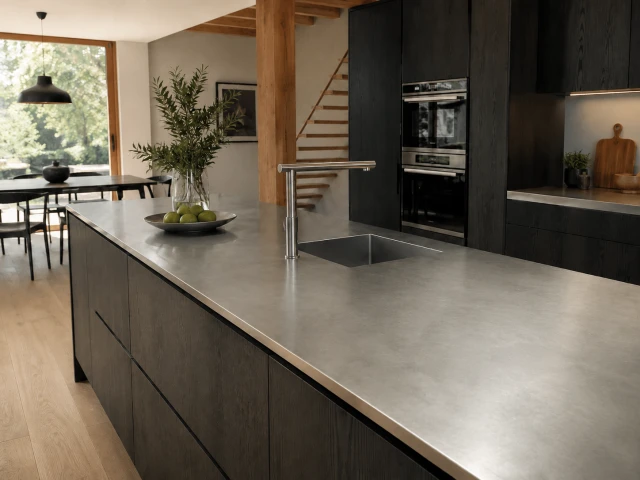
Brushed stainless steel is often chosen when the surface remains visible. Think of interior construction, mechanical engineering, appliance manufacturing, architecture and design.
A brushed stainless steel sheet has a recognisable linear finish. Matt, calm and consistent. Not reflective, but well finished.
With brushed stainless steel, consistency is especially important. The direction, structure and intensity all have to be right. Especially with larger sheets or multiple parts placed next to each other, every difference stands out.
We brush stainless steel sheets mechanically, so the linear finish remains controllable and reproducible. That makes the finish suitable for one-off pieces as well as series-produced sheet metal.

The terms are often used interchangeably. Still, there are differences in both the process and the result.
Stainless steel grinding is usually the basic operation. It makes the surface flatter, more even and cleaner. It also allows us to apply a clear grinding direction.
Stainless steel sanding is often used to refine, matt or prepare the surface for a next step.
Stainless steel brushing is mainly about the visible final appearance. The surface gets an even, matt linear structure.
Which process is needed depends on the application. A functional component requires something different from a visible panel in an interior or a part for a hygienic environment.
After grinding, sanding or brushing, a stainless steel sheet can be polished further.
Polishing stainless steel sheets reduces surface roughness and gives the material a finer appearance. That is important for visible parts, but also for applications where cleanability plays a role.
Polishing is often suitable for:
food and pharma
high-tech components
mechanical engineering
visible parts
components with low Ra values
high-gloss or mirror-finish stainless steel
We build up the finish step by step. First, we create a solid base. Then we polish further to the required level. From matt and functional to high-gloss or mirror-like.
Not every stainless steel sheet needs the same finish. The right choice depends on what the sheet has to do.
That is why we look at questions such as:
Will the surface be visible?
Does it need to be easy to clean?
Is a specific Ra value required?
Does the grinding direction need to be fixed?
Is it a one-off part or series production?
Will the sheet be welded, assembled or treated further later on?
Grinding, sanding, brushing and polishing are means to an end. The goal is a stainless steel finish that fits the product.
Van Geenen processes stainless steel sheets in-house. We can also grind, sand, brush and polish larger sheets mechanically.
That gives us control over the process. And you can see that in the result: an even grinding pattern, a calm structure and a finish that suits the application.
For every request, we look at the dimensions, material grade, required grit, direction and final finish. This prevents unnecessary steps and helps us choose a process that is technically and practically right.
Ground and brushed stainless steel sheet metal is used in many sectors. Wherever the surface matters for appearance, cleaning or use.
Examples include:
mechanical engineering
food industry
pharma
high-tech
interior construction
architecture
appliance manufacturing
design and visible work
A good stainless steel finish prevents problems later on. The surface is easier to control, meets the technical requirements and looks the way it should.
Van Geenen takes care of it: smarter, faster and efficient. No fuss, no middlemen - just complete, high-quality finishes from A to Z.
We build lasting relationships, with personal contact and honest advice. Always involved, always accessible.
With generations of knowledge, high-end techniques and attention to detail, we deliver quality without concessions. This is how we proudly put our signature on every project.
Do you want to have stainless steel sheets ground, stainless steel sheets sanded, stainless steel brushed or stainless steel sheets polished? Then it starts with choosing the right finish.
At Van Geenen, we think along with you. We look at the material, the application and the desired final result.
Does the surface need to be functional?
Does it need a clean brushed finish?
Is a lower Ra value required?
Or is high-gloss polishing the best next step?
We do not make it sound better than it is. We simply make it right.
Van Geenen.
Finishing every challenge.
